A Jive Down Memory Lane – The Swinging Sixties
by
Den Stevenson
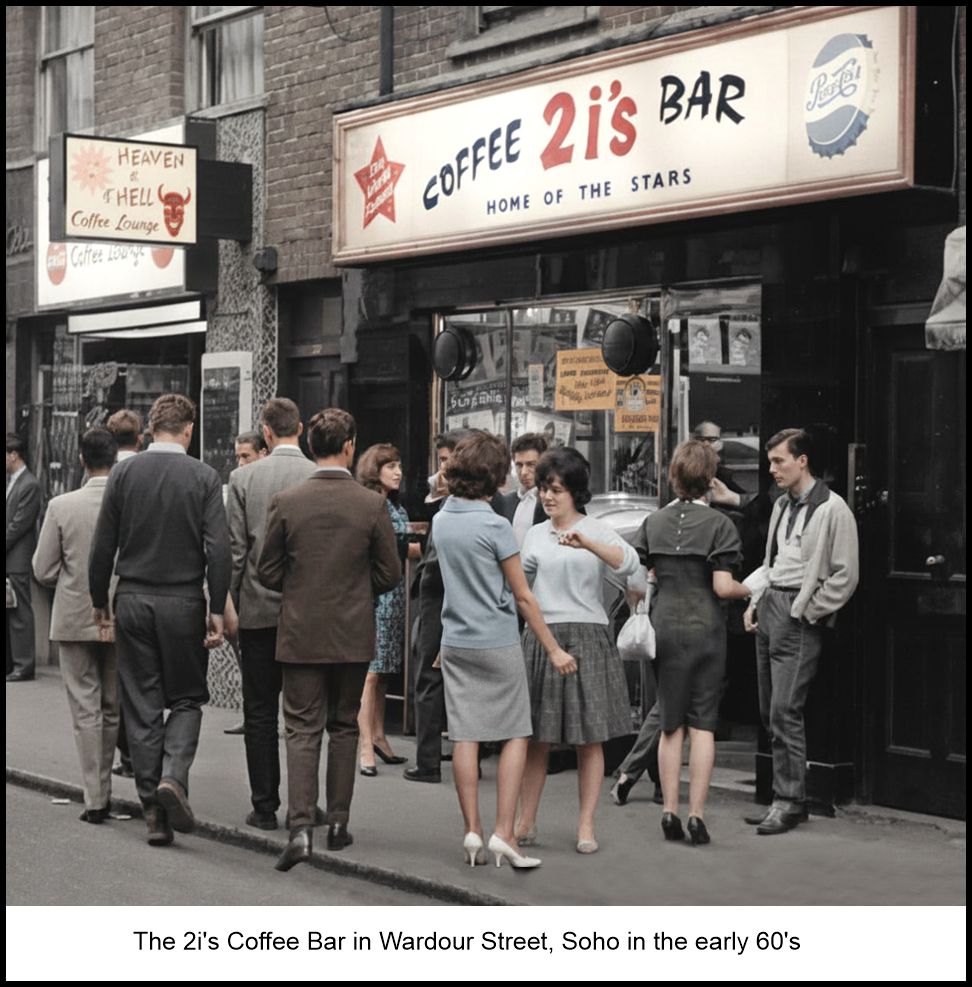 |
I swung into the 60’s music scene off the back of Trad Jazz; mainly because of being in the only white band playing ‘Blue Beat’ and getting a gig in the now famed 2i’s Coffee Bar located in the heart of London’s notoriously debauched Soho by my telling a fib that we were a Liverpool band. Somehow, I managed to get away with my Scouse accent which went right out of the window on our first performance! But now at least my band, The Karnelles were starting to climb the ladder.
The 2i's gig led to appearances later at the Flamingo Club, 100 Club and the now famed Marquee Club at 90 Wardour Street where almost every major rock band of note played over the next 25 years on its tiny stage. Residence during the late 60’s alone included Alexis Korner; Chris Barber; the Rolling Stones; The Yardbirds; Led Zeppelin; The Who; Jethro Tull; The Jimmy Hendrix Experience and Pink Floyd. Also, the Manish Boys featuring David Bowie and Peter Green’s Fleetwood Mac. In 1964 the Moody Blues used a homemade studio in the garage at the back of the Club to produce ‘Go Now’ which shot to Number 1 Christmas 1964 and the studio was later used by Elton John; The Groundhogs and The Clash. To find out who was playing there on any given night you could just call in at the ‘Ship’ Pub a few doors away where I admit to downing my share of pints. It was a planet away and an entirely different environment from the one in which I had grown up in amongst the apple orchards and hop fields in the county heralded the Garden of England where on a daily basis, I rubbed shoulders with the baby boom rock ‘n’ roll mix of budding hopeful bands and managers in a red neon lit heady frontier atmosphere of prostitutes; strip clubs; pimps and gangsters encountering names still wet in the pages of music and criminal history. Gene Vincent first excited and overflowed my music buds when I saw him live at the Sunderland Empire in the early 60’s.
 |
I stood transfixed only feet away from this even then legend as he, attired in all black biker leather with bad teeth and black hair smeared down with Brylcream, projected pure raw unadulterated gyrating energy giving out rock ‘n’ roll vibes like volts of electricity that charged the mind and body. I’d never heard anything like it before nor have I since. It gripped my very guts and left me wanting much more. Soon after, he was dead; killed in a motor bike accident. I may never have seen Elvis live but that night I’d seen the best!
My first abiding memory of the famous 2i’s coffee bar is of a mini skirted Brigitte Bond, a Brigitte Bardot look alike, sprawled along the countertop that ran the length of the entrance area behind which shone a range of metal frothy coffee machines accompanied by their continuous frothy making acoustics. Turn right at the back down a flight of narrow stairs to the basement and a single small room that I recall could accommodate about fifty at a squeeze! It had just one minute excuse of a window at pavement level and the bustling sordid Soho night life outside. Such was the limited area; we were confined to try and play behind a row of school benches as the packed room heaved and condensation ran down the walls. This then is where it all started!! The well head of a new musical generation that first spawned and offered the talent of Tommy Steele swiftly followed by Cliff Richard! Surely the Shadows didn’t back him down in that grotty little room? The coffee bar was run by one Siggy Jackson the brother of a well-known radio DJ Jack Jackson who for some reason played the sound of a black cat meowing on his program! Siggy knew everyone who was anyone in the music business and was the key to getting what every aspiring band and manager wanted…a record deal.
 |
Siggy flitted from club to club holding court in pubs; bars and restaurants always doing deals. A true 60’s Mr Fixit. He was very astute and immediately saw the financial potential of a white band playing what was considered the province of blacks only giving us more attention than most and in no time, he had arranged for me to go to London airport to meet the legendary Prince Buster who was scheduled to tour the country. Never having sat in anything more spectacular than a Vauxhall Viva the arrival of a white Rolls Royce to take me to the airport was the equivalent of a luxury only enjoyed by those born with a silver spoon in their mouth or won the football pools. Mickey Finn; lead singer in a Blue Beat band was already entrenched in the front next to the chauffer so I got into the back and found myself sitting next to Brigette Bond wearing an even shorter mini skirt than usual! That was an interesting journey!!
When we alighted at the airport to be met by Siggy; Mickey quickly found time to tell me the good news that Brigitte had the hots for me ever since our first gig at the 2i’s! There swiftly followed the bad news. He warned me only to put my hand up her skirt if I didn’t mind the fact Brigitte was a former French sailor who was in the process of having a sex change operation and still had his/her dangling bits! Prince Buster shook my hand warmly and I engineered him and Mickey to sit next to Brigitte on the return journey by promptly taking up residence in the front seat. Be careful Buster I thought, as I saw him eye Brigitte lustfully. I thought… better wash the pum pum after Buster!
The band was named after lead guitarist Mickey Waller aka 'Mickey Finn' which evolved out of a Shadows-like instrumental band called The Strangers and put together in Bethnal Green East London in 1961 and by 1963 they had become a much more R&B orientated group. By 1963 Waller had left the band to form a more ‘mod’ sounding band and became bitten by the Jamaican Blue Beat bug whilst hanging out at the Crypt Club in Aldgate and decided to concentrate on his music forming a new band recruiting John Cooke aka ‘Fluff’ on keyboards and Alan Marks on vocals. After hearing of a drummer of the same name with Cyril Davis & His R&B All Stars Waller changed his name to Finn and became Mickey Finn & the Blue Men (whilst I knew it as Mickey Finn & the Finn Men); their Agent Don White secured the band a recording contract with Blue Beat Records which released their debut single including a rendition of Elias & The Zig-Zag Jive Flutes ‘Tom Hark’ coupled with ‘Please Love Me’ composed by Alan Hawkshaw of Emile Ford & the Checkmates in 1964. After a couple of months, they switched to Oriole Records with Jimmy Page. Mickey carried on playing until 1978; then took a sabbatical until 1999 when he reformed the Blue Men playing until his death in 2013.
 |
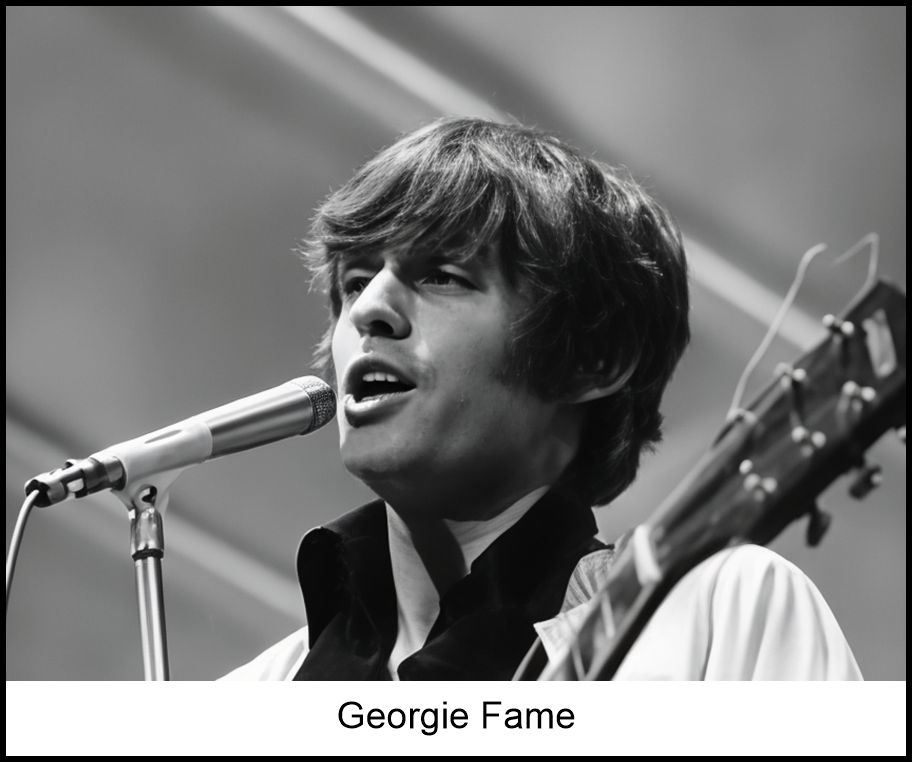 |
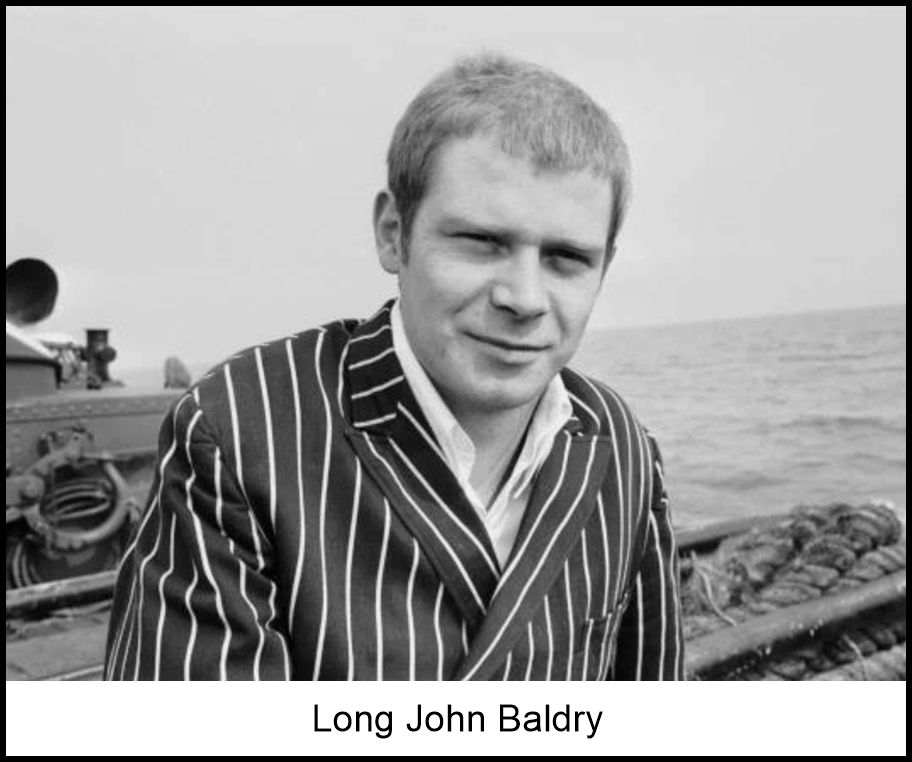
I spent the rest of my time in Soho avoiding Brigitte’s constant pursuance but admit to often wondering whether Micky had fed me false information simply so he could enjoy her delights as he openly flaunted an increasingly closer liaison much to Busters increasing chagrin. I determined not to find out and blinkered myself to the band’s success and was delighted when Siggy told me we were to accompany Prince Buster on tour along with Millie; she of the classic ‘My Boy Lollipop’. We later met Millie at the Hermitage in Hitchin, resident home of the Baron Knights. Siggy also had plans for Brigitte to cut a record, and we found ourselves on stage in the Flamingo Club as she struggled to sing the chosen song. Unfortunately, it soon became apparent, Brigitte had a memory problem when it came to lyrics, and it was soon decided they would be written on a huge cue board in large capital letters and held up for her to read. Whilst this was being done, Siggy seconded the Flamingo tea boy, a certain Elton John, feeling the song would benefit from an impromptu tinkle on the ivories whilst I was relegated to holding the cue board! On resumption, embarrassingly, Brigitte was more interested in showing me how she felt rather than read the lyrics and continually pouted at me whilst she evocatively felt her newly created crotch (I’d been told she’d had the operation) barely hidden by another micro mini to the amusement of Long John Baldry and Georgie Fame.
 |
Siggy got increasingly irate; particularly when the lyrics Brigitte did manage to sing were totally out of key! Needless to say; the record was never cut. Many years later, I was scanning the News of the World when a headline caught my eye. Lord marries pop star!! There, large as life, was a picture of Brigitte; beside the Jacobean mansion in which she would live set in thousands of sprawling English acres with the quote ‘Brigitte said she is looking forward to having lots of children: “I want at least seven” she cooed…’ His Lordship was clearly oblivious to the fact she would never be able to produce little Heirlets! Realizing she was never going to make the charts; dear old Siggy had obviously ferreted out a potentially very nice little earner thank you. Call me suspicious but would you want the truth to out if you were the Lord? Not literally of course. I just hoped the utter impossibility of Brigitte adding to the heraldic lineage did not spoil things and they both lived happily ever after. Well, some stories have happy endings; don’t they? We were offered ‘Humpty Dumpty’ to record as a Blue Beat number and afforded the luxury of a brass section that included famed saxophonist Red Price. Sadly, things did not work out as our lead singer, at that critical moment, decided to confess to a colour prejudice. On calling to pick him up for a gig he blatantly refused to sing to such a tanned audience at which point I forcefully abducted; tied up and bundled him into the band’s 30cwt Comer van! This extreme measure ensured it was to be his last performance for the Karnelles and therefore we fell off the recording wall and the opportunity was given to The Migil Five who not only made the top ten but, as a result, got on to Top of the Pops. Every bands dream back then!
 |
 |
While still a student Jimmy Page often performed on stage at The Marquee with bands such as the Cyril Davies All Stars, Alexis Korner's Blues Incorporated and fellow guitarists Jeff Beck and Eric Clapton. He was spotted one night by John Gibb of Brian Howard & the Silhouettes who asked him to help record some singles for Columbia Graphophone Company including ‘The Worrying Kind’. Mike Leander of Decca Records first offered Page regular studio work. His first session for the label was the recording ‘Diamonds’ by Jet Harris and Tony Meehan which went to Number 1 on the singles chart in early 1963. After brief stints with Carter-Lewis and the Southerners; Mike Hurst and the Method and Mickey Finn and the Blue Men; Page committed himself to full-time session work. As a session guitarist, he was known as 'Lil' Jim Pea' to prevent confusion with the other noted English session guitarist Big Jim Sullivan. Page was mainly called into sessions as ‘insurance’ in instances when a replacement or second guitarist was required by the recording artist. “It was usually me and a drummer” he explained. "Though they never mention the drummer these days; just me. Anyone needing a guitarist either went to Big Jim (Sullivan) or myself.” He stated that: “In the initial stages they just said, play what you want cos at that time I couldn't read music or anything."
Jimmy Page is credited for the innovations in sound recording he brought to the studio during the years he was a member of Led Zeppelin; many of which he had initially developed as a session musician. This apprenticeship became a part of (learning) how things were recorded. I started to learn microphone placements and things like that, what did and what didn't work. I certainly knew what did and didn't work with drummers because they put drummers in these little sound booths that had no sound deflection at all and the drums would just sound awful. The reality of it is the drum is a musical instrument; it relies on having a bright room and a live room..... And so, bit by bit I was learning how not to record. He developed a reputation for employing effects in new ways and trying out different methods of using microphones and amplification. During the late 1960s, most British music producers placed microphones directly in front of amplifiers and drums, resulting in the sometimes ‘tinny’ sound of the recordings of the era. He felt the drum sounds of the day in particular: "sounded like cardboard boxes!” Instead, he was a fan of 1950s recording techniques.
‘Recording used to be a science, engineers used to have a maxim, distance equals depth’. Taking this maxim to heart, he developed the idea of placing an additional microphone some distance from the amplifier (as much as twenty feet) and then recording the balance between the two. By adopting this technique, he became one of the first British producers to record a band's ‘ambient sound’, the distance of a note's time-lag from one end of the room to the other. This production technique involved hearing the echo before the main sound instead of after it, achieved by turning the tape over and employing the echo on a spare track, then turning the tape back over again to get the echo preceding the signal. Page stated that as producer, he deliberately changed the audio engineers on Led Zeppelin albums. He explained: "I consciously kept changing engineers because I didn't want people to think that they were responsible for our sound. I wanted people to know it was me.” John Paul Jones acknowledged that Page's production techniques were a key component of the success of Led Zeppelin: “The backwards echo stuff [and] a lot of the microphone techniques were just inspired. Using distance-miking and small amplifiers. Everybody thinks we go in the studio with huge walls of amplifiers, but Page doesn't. He uses a really small amplifier, and he just mikes it up really well, so that it fits into a sonic picture.” In an interview that Page himself gave to Guitar World magazine in 1993, he remarked on his work as a producer: “Many people think of me as just a riff guitarist, but I think of myself in broader terms ... As a record producer I would like to be remembered as someone who was able to sustain a band of unquestionable individual talent and push it to the forefront during its working career. I think I really captured the best of our output, growth, change and maturity on tape – the multifaceted gem that is Led Zeppelin.”
 |
Nobody else put us back together again; despite my locating an incredible performer with a fantastic rock voice called Cuddles who I had seen sing and met in the 2i’s who I only knew by his nick name when he said he had gone down to the Smoke from Sheffield to try and get a record deal and hooked up with Georgie Fame.
 |
I put an advertisement in the NME with my telephone number asking if Cuddles would contact me and hey-presto he rang and sang with the band at the California Dance Hall located on Dunstable Downs when we played support to Freddie & the Dreamers; Cuddles performance was electric.
I can see him now, swinging from a small balcony opposite the main stage like a demented Orangutan who was celebrating his escape from nearby Whipsnade Zoo! Pure unforgettable magic and nothing short of what the public would later come to expect when Cuddles (aka Joe Cocker) performed as his music career soared to where only Eagles dare to fly and the Karnelles sank without trace like the Titanic to rock bottom and oblivion. After which I brought down the mental shutters on my love affair with music for a quarter of a century and got on with married life; a wife and two children to support.
The 30cwt Comer had been ideal transport for the band particularly if you didn’t draw the short straw. In a previous life, it had been used to deliver clothes in London and had a centrally fitted hanging bar in the sectioned off unheated back where the ‘unfortunates’ got to stand, like underground commuters, holding their instrument cases in one hand with the other grasping the rail!
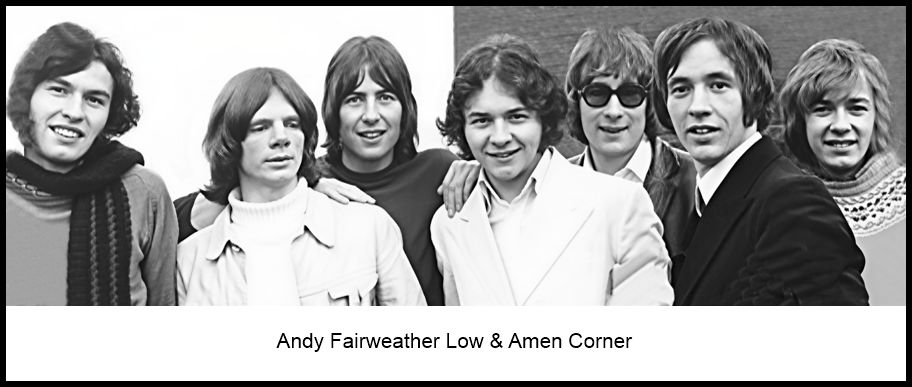
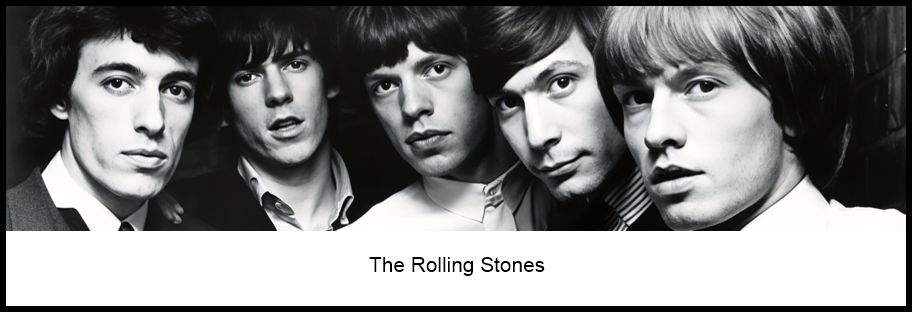
The ‘fortunates’ who occupied the front enjoyed the luxury of sitting down in the glorious warmth generated through the bulbous engine cover in the cab. It was particularly enjoyable for the jackpot winner who actually got to sit on it. Another van bonus was the fact the double back doors only opened as wide as the vehicle, which in the narrow Soho streets, was vital when unloading the gear in haste particularly as, in the course of an evening, the band would often play two or sometimes three gigs! After the last gig we usually took on petrol in Wardour Street before heading for the Spiders Web at the end of the M1, the best café in the country, where each of us would order a double full English; three slices of toast and a large mug of tea! On one occasion, as I was carrying out my petrol filling duty, a long-haired youth who clearly had been performing on the same gig circuit decided to urinate against the petrol pump I was operating. His instant response to my: “You dirty bastard” was "I’m Mick Jagger, I can piss where I like". I hope he’s given up the filthy habit… and, no Mick, I don’t still love you now you’re sixty-four. The Rolling Stones (to me) were all posh voices trying to be rebels with no class and never in the same class as The Beatles. Personally, I preferred Zoot Money's Big Roll Band and Amen Corner lead by the charismatic Andy Fairweather Low; in my book one of the finest front men in pop history.
 |
In the swinging sixties there was a unified bond between bands on the road. We all chased the same Top of the Pops dream as we rode the helter-skelter multi-coloured train on a magical mystery tour not knowing when or if ever the ride would end totally oblivious, we were just mere dolphins in a sea of waiting basking sharks waiting to be screwed!